 EN
 ES
Illustration of the Alleged Scheme Between Judge Charles P. Sifton and Attorney Jonathan A. Bernstein
Updates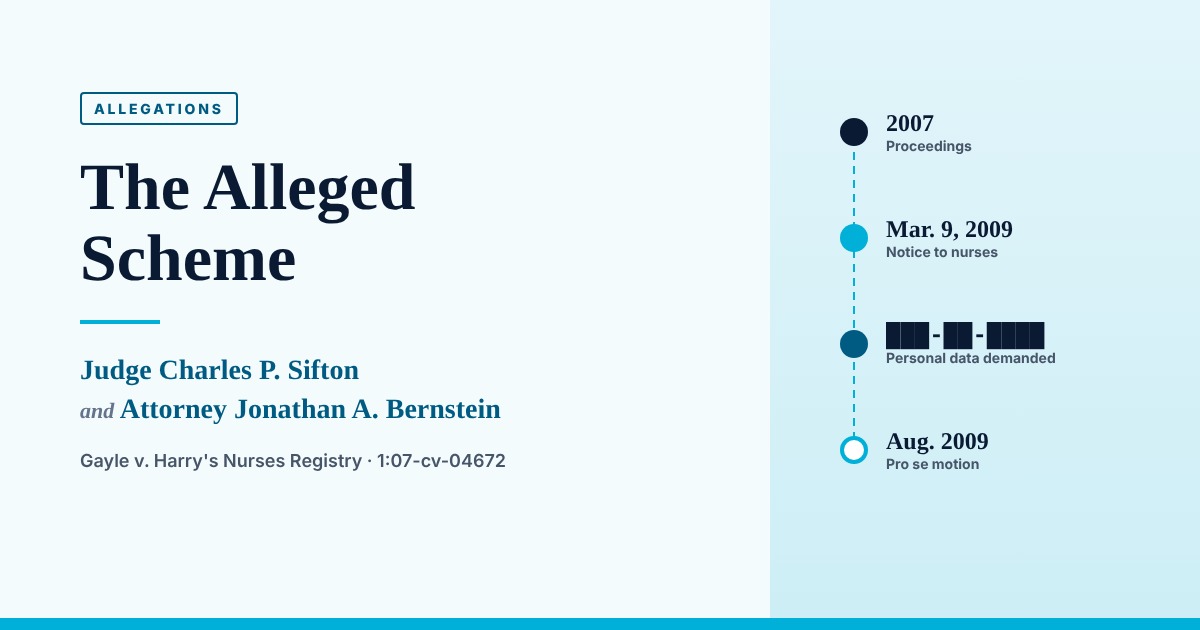
This illustration examines the alleged scheme involving Judge Charles P. Sifton and attorney Jonathan A. Bernstein surrounding the March 9, 2009 questionnaire sent to nurses associated with Harry’s Nurses Registry, Inc. It highlights allegations concerning the collection of nurses' personal information, the classification of nurses as employees or independent contractors, and potential violations of constitutional rights. It also addresses Harry Dorvilier's objections to the proceedings and his August 2009 pro se motion challenging the court's actions.
The claims in this article are allegations raised by Harry Dorvilier. They have not been proven and require verification against the original court records.
In Gayle v. Harry's Nurses Registry, Inc. (1:07-cv-04672, E.D.N.Y.), Harry Dorvilier alleges that a March 9, 2009 notice sent to nurses was part of a scheme connecting Judge Charles P. Sifton and attorney Jonathan A. Bernstein.
The Five Questions in the March 9, 2009 Notice
1
Why did I get this notice?
Harry's records show you work or worked there as a registry, field or per diem nurse. On March 9, 2009, Senior Judge Charles P. Sifton authorized sending this Notice about your right to join the lawsuit.
2
What is a collective action and who is involved?
People with similar claims against an employer sue together. The document states the Court determined Harry's registry nurses were entitled to time and a half for overtime.
3
What does the lawsuit complain about?
Plaintiffs claim Harry's misclassified registry nurses as "independent contractors" and owes unpaid overtime, damages and attorneys' fees.
4
How does Harry's answer?
Harry's asserted it acted in good faith in applying the FLSA to its employees.
5
Has the Court decided who is right?
The document states the Court decided for the plaintiffs. Only "similarly situated" people may participate, and Harry's will likely ask the Court to review each nurse's circumstances.
The Alleged Scheme
According to Harry Dorvilier, the questions sent to nurses by attorney Jonathan A. Bernstein on March 9, 2009 were part of a scheme involving Judge Sifton, Bernstein, Harry's Nurses Registry and Harry Dorvilier. The alleged purpose was to obtain a list of nurses associated with Harry's. Nurses were reportedly required to take an oath before November 7, 2007.
2007 proceedings → March 9, 2009 notice → nurses' personal data → August 2009 motion
Nurses' Personal Information
The partial summary judgment required disclosure of nurses' names, dates of birth and Social Security numbers from 2004 to the present. Harry Dorvilier alleges this violates the nurses' privacy and their rights under the First, Sixth and Fourteenth Amendments.
Employee or Independent Contractor?
Five requirements must be considered to decide whether a nurse is an employee or an independent contractor: control over the work, opportunity for profit or loss, skill and initiative, permanence of the relationship, and whether the work is integral to the business.
In Harry Dorvilier's view, the 2009 summary judgment did not properly establish that the nurses were employees under FLSA Section 216(b). Each nurse's circumstances should have been examined first.
The August 2009 Pro Se Motion
In August 2009, Harry Dorvilier filed a pro se motion to explain what he believed was an error by the federal court. According to Dorvilier, the motion was never properly addressed, no explanation came, and the First, Sixth and Fourteenth Amendment concerns remain unresolved.
In our view, the nurses' constitutional rights, their privacy, their classification under the FLSA and the court's handling of the August 2009 motion all deserve clear answers.
Sources: Court-authorized Notice (March 9, 2009), Gayle v. Harry's Nurses Registry, Inc., No. 1:07-cv-04672 (E.D.N.Y.); allegations of Harry Dorvilier. Five-factor test: Brock v. Superior Care, Inc., 840 F.2d 1054 (2d Cir. 1988).
Related Posts