 EN
 ES
How Does a Fair Labor Standards Act Claim End Up in Federal Court?
News
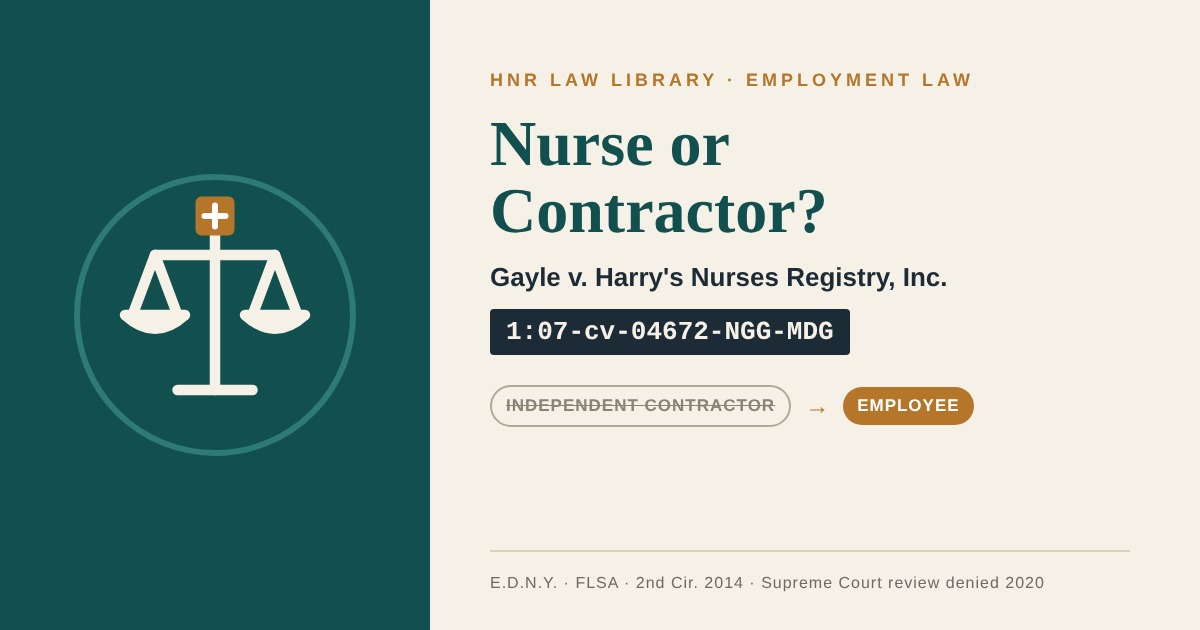
A wage case brought under the Fair Labor Standards Act ended in summary judgment for a plaintiff who appeared under three different names. Before any federal court can rule, the plaintiff must have standing and the court must have jurisdiction. Here is what those rules mean, and the questions this case raises.
The Case
A Fair Labor Standards Act case was brought in federal court by a plaintiff identified as Claudia Gayle. The same plaintiff has also appeared as Claudia Matthias and Claudia Williams. Her identity as a party plaintiff was never established, yet she obtained summary judgment.
After summary judgment was granted, the defense asked the judge to correct mistakes in procedure and in law. The judge refused. One basic question was never answered: how did Claudia Gayle become Claudia Williams in 2023?
The defense also points to a wider pattern. The same attorney, Jonathan Bernstein, is tied to case number 23-cv-06661 in the Western District of New York, a pro se prisoner civil rights case under Section 1983. In cases like that, someone held by the state claims a civil rights violation, then goes to federal court for money damages. The defense sees the same pattern in the Gayle case and in the state case of Mr. Tafari, who was held in state prison: the criminal records of someone in state custody are used to bring a civil case in federal court.
To understand why this matters, it helps to look at the two rules every federal court must satisfy before it can rule on any case: standing and subject matter jurisdiction.
Article III Standing
Under Article III of the Constitution, federal courts can only hear real “cases and controversies.” They cannot rule on a question just because someone disagrees with a law or policy. To bring a case, a plaintiff must have standing, meaning a real, concrete, personal injury.
Senator Ted Cruz pressed this point with Judge Ketanji Brown Jackson during her 2022 Supreme Court confirmation hearing. Using a lawsuit against Harvard as an example, Cruz asked whether someone who is not personally harmed by a policy can still sue over it. Jackson agreed that a plaintiff must have an actual injury, and that the court must find one before it has subject matter jurisdiction to hear the case. Cruz then asked whether a person could gain standing simply by changing how they identify. Jackson declined to answer the hypothetical, saying she would decide standing based on the arguments, precedent, and constitutional principles.
The point is simple: standing depends on who the plaintiff is and whether that person was actually injured.
Watch the full exchange between Senator Cruz and Judge Jackson:Subject Matter Jurisdiction: 28 U.S.C. §§ 1331 and 1332
Standing is only the first requirement. A federal court must also have the legal power to hear the type of case in front of it. Sections 1331 and 1332 of Title 28 of the United States Code give federal courts that power. They also play a role in preventing false accusations and keeping the legal system fair.
Section 1331: Federal Question Jurisdiction
Section 1331 grants federal courts the authority to hear cases involving federal law. If a case arises from a federal law or constitutional question, it can be brought in federal court.
When individuals or entities are accused of violating federal laws or constitutional provisions, they have the option to have their cases heard in federal court. This ensures that complex or disputed federal legal issues are resolved at a higher level of expertise. It helps safeguard against baseless claims by providing a forum where legal standards and precedents are rigorously applied, reducing the likelihood of frivolous accusations.
Section 1332: Diversity Jurisdiction
Section 1332 provides federal court jurisdiction when the parties are citizens of different states and the amount in controversy exceeds a specified threshold. It allows individuals and entities from different states to litigate their disputes in federal court rather than state court, promoting fairness and impartiality.
This minimizes the potential for local bias that may exist in state courts. By providing a neutral forum, it discourages false or exaggerated accusations motivated by local prejudice and encourages a more impartial and objective assessment of the case, reducing the risk of meritless claims driven by local interests.
Together, sections 1331 and 1332 offer fair and impartial venues for resolving legal disputes, whether they involve federal law or parties from different states, so that cases are heard where the risk of false or unfounded accusations is minimized.
Watch the explanation of federal question and diversity jurisdiction:Conclusion
A Fair Labor Standards Act claim can reach federal court because it arises under federal law. But federal law opening the courthouse door is not enough. As Senator Cruz and Judge Jackson discussed, Article III still requires a real plaintiff with a real injury. Without an identified plaintiff, there is no standing, and without standing, the court has no jurisdiction to rule.
In the defense’s view, the Gayle case fails that test. Claudia Gayle, Claudia Matthias, and Claudia Williams were, in the defense’s words, ghosts. A criminal complaint was filed on the tax liability, but no summons and complaint was ever issued to bring the culpable officer to justice. Taking matters rooted in state criminal records and turning them into federal civil cases under the Fair Labor Standards Act, the defense argues, is an orchestrated scheme to put cases on the court calendar for monetary gain, and those cases lack subject matter jurisdiction.
The questions that remain:
- How can a plaintiff who never established her identity become a party plaintiff?
- How did Claudia Gayle become Claudia Williams in 2023?
- Why did the judge refuse to correct the errors of procedure and law?
- How does a matter rooted in state criminal records become a federal civil case for money damages?
- Without a real, identified plaintiff, where is the subject matter jurisdiction?
Video
Related Posts